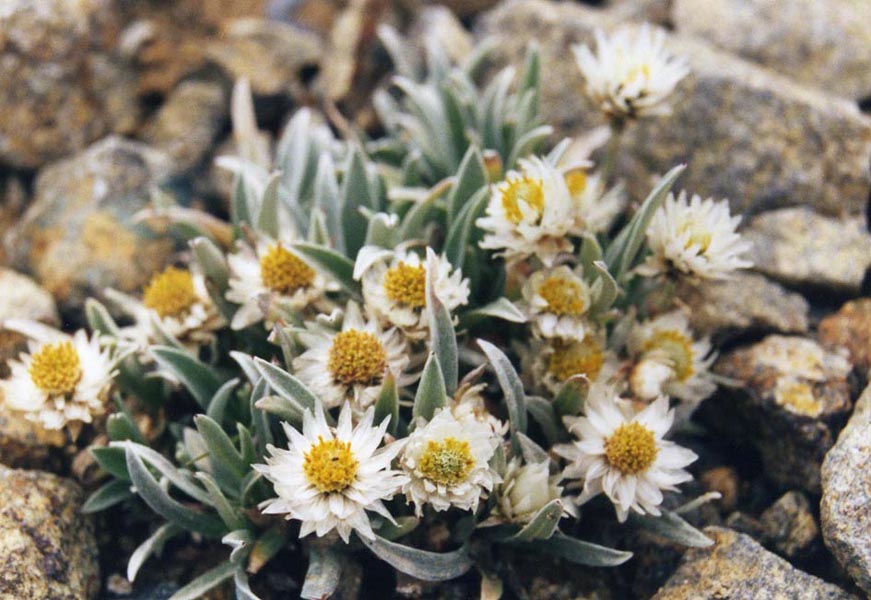
Dwarf and compact variety of the species, originating from the upper alpine levels of the Himalayas, growing at even higher altitudes than the typical form, in harsher conditions, which explains its considerably reduced stature. Its name, from the Greek monos (single) and kephalê (head), reflects its tendency to bear only a single flower head or a very small number of flower heads per stem, unlike the abundant corymbs of the typical form.
It forms small, very dense and low tufts, generally not exceeding 10 to 15 centimeters in height, with similarly silver-woolly foliage, but proportionally wider relative to the size of the plant, giving it a very characteristic stocky and compact appearance. The flower heads, borne on short upright stems, are relatively large compared to the size of the plant, with the same persistent papery white bracts as the typical species.
This variety is particularly appreciated in rock gardens and alpine cultivation, where its reduced size and silver-white foliage harmoniously integrate among the stones. It shares with the typical form its relative tolerance to moisture, a valuable quality in rock gardens. Its hardiness is excellent. It propagates by division in spring and can also be obtained by sowing, although the variety is sometimes less stable than the typical species by this method.