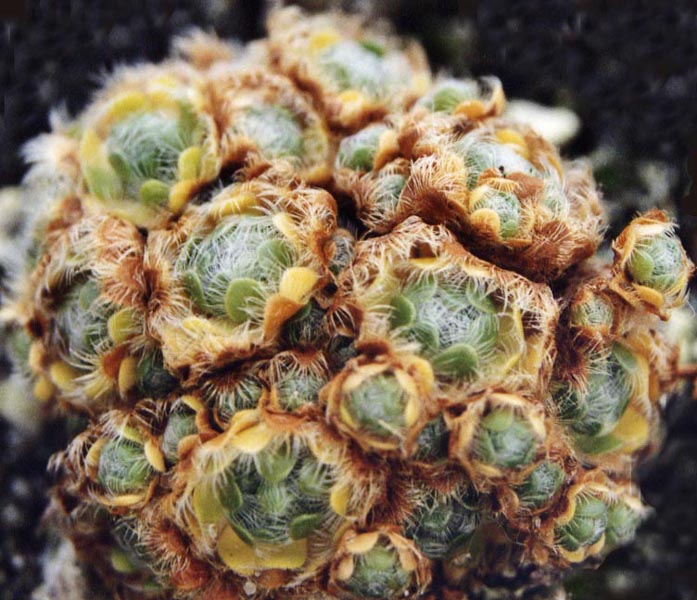
- Winter foliage -
- Winter foliage -
Dwarf perennial of the Primulaceae family, native to the high mountains of Yunnan and Sichuan, in southwestern China, where it was discovered and collected by Father Jean-Marie Delavay, a French missionary and botanist whose collections from the late 19th century greatly enriched the knowledge of Chinese flora and European horticultural collections. It grows in alpine meadows, rock gardens, and granite screes between 3,500 and 5,000 meters altitude, in conditions of a continental high-altitude climate marked by cold, dry winters and cool, relatively wet summers.
It forms small dense and compact cushions, composed of numerous very tight rosettes with narrowly spatulate, very short leaves, covered with fine glandular hairs that give them a slightly sticky appearance and a particular texture. The flowers, pure white to slightly pinkish white, are borne individually or in very small umbels on extremely short peduncles, almost sessile on the rosettes, creating a flowering effect flush with the cushion of great delicacy. The central eye is bright yellow.
A specialist's plant requiring impeccable drainage and winter protection against moisture, it is cultivated in pots under cold shelter or in an alpine greenhouse. Although difficult to maintain sustainably in cultivation, it is held in high esteem for the purity of its white flowers and the perfection of its miniature cushions. Propagation by fresh seed sowing is the most reliable method to renew collections.