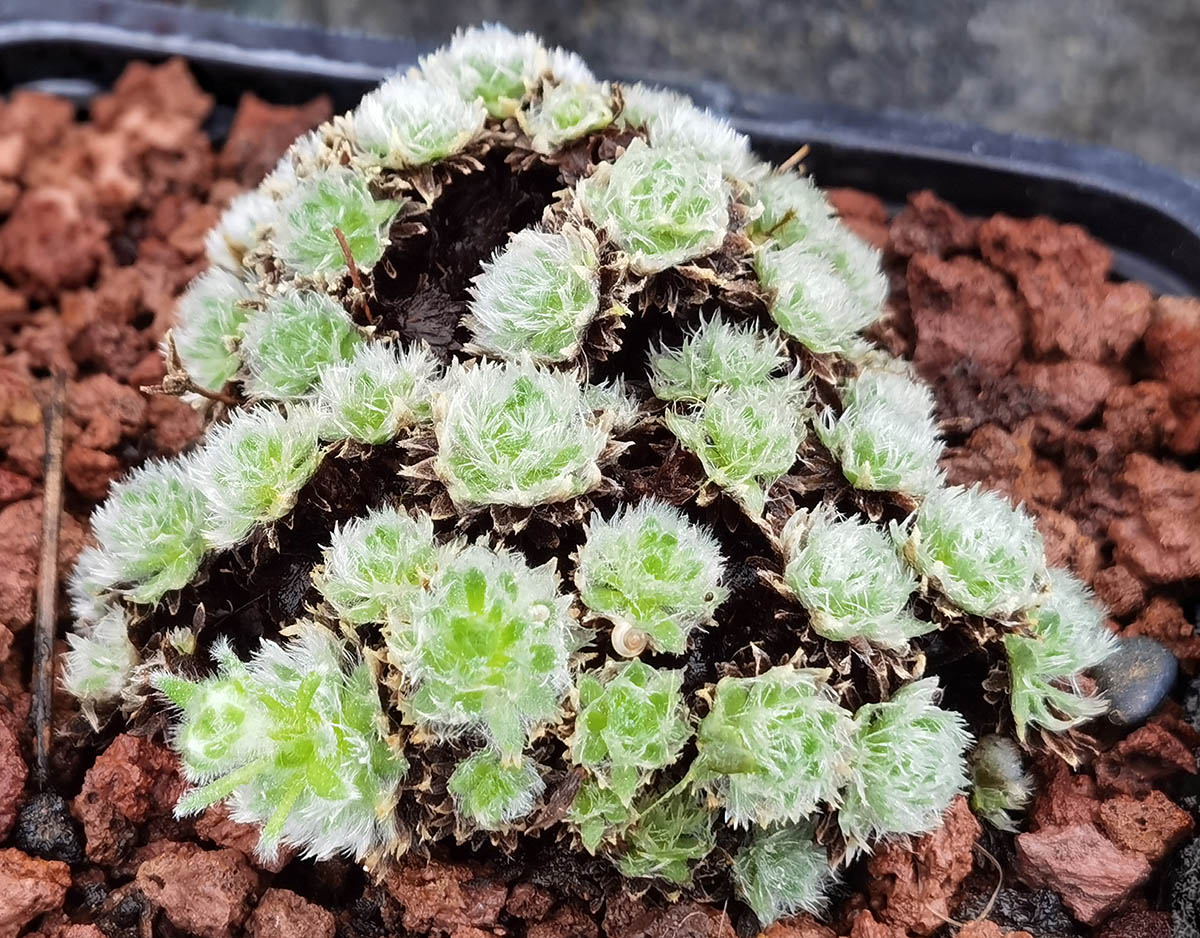
Jacquemont's Androsace, robust variety. The species Androsace jacquemontii , dedicated to the French naturalist and traveler Victor Jacquemont who explored the Himalayas and Kashmir in the years 1820-1832, is a dwarf perennial native to the western Himalayas, from Pakistan to northwestern India, growing in alpine meadows, screes, and moraines between 3,500 and 5,500 meters altitude. The variety robusta differs from the typical form by a slightly larger size, more developed rosettes, and a generally more vigorous constitution, making it more accessible in cultivation while retaining the ornamental qualities of the species.
It forms loose to moderately dense tufts, the rosettes composed of oblong, green leaves covered with whitish woolly hairs. The flowers are bright pink to carmine pink, a more intense color than many Himalayan androsaces, borne in umbels on short stems, creating a striking contrast with the silvery-green foliage. Blooming occurs in June-July.
The variety robusta , as its name suggests, is generally considered easier to cultivate than the type, better tolerating the standard growing conditions of Himalayan alpine plants. Well-drained substrate, slightly acidic to neutral, protection against excessive winter moisture, bright exposure. It can be grown in pots or troughs, and is suitable for enthusiasts wishing to explore Himalayan androsaces without immediately tackling the most difficult species.