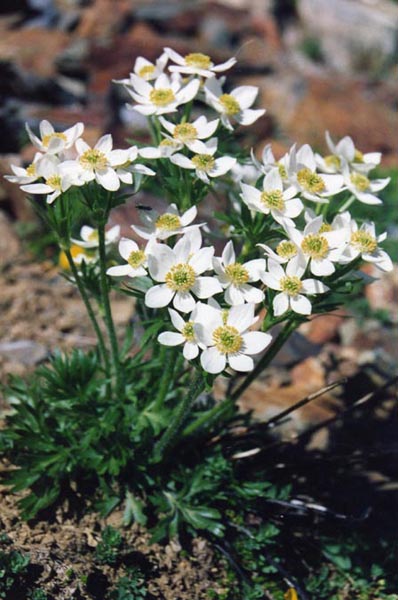
Mountain perennial belonging to the Ranunculaceae family, widely distributed across the major mountain ranges of the northern hemisphere: Alps, Apennines, Carpathians, Balkans, Caucasus, Urals, Siberia, Central Asia, Japan, and locally in North America. Grows on alpine grasslands, high-altitude pastures, tall herb communities, and edges of open forests, between approximately 1,500 and 2,800 meters, on fresh, humus-rich, and well-drained soils.
Forms a basal clump of long-petioled, palmately divided leaves with narrow, deeply cut segments, of a bright green. Erect flowering stem 20 to 50 cm tall, bearing at its top an umbel of 3 to 8 flowers — an immediate distinguishing feature compared to solitary-flowered anemones —, each composed of 5 to 6 oval white tepals, often slightly tinged with pink or purple on the reverse, surrounding a central yellow-green cluster of numerous stamens. The entire umbel indeed evokes, by its arrangement and whiteness, a cluster of daffodils, hence the species name.
Blooms from June to August depending on altitude. Protected plant in several European countries due to its rarity linked to overgrazing and picking. Little cultivated in gardens, it requires conditions close to its natural habitat: fresh, humus-rich soil, cool exposure, altitude or mountain microclimate. Interesting in large-volume alpine rock gardens or mountain gardens.