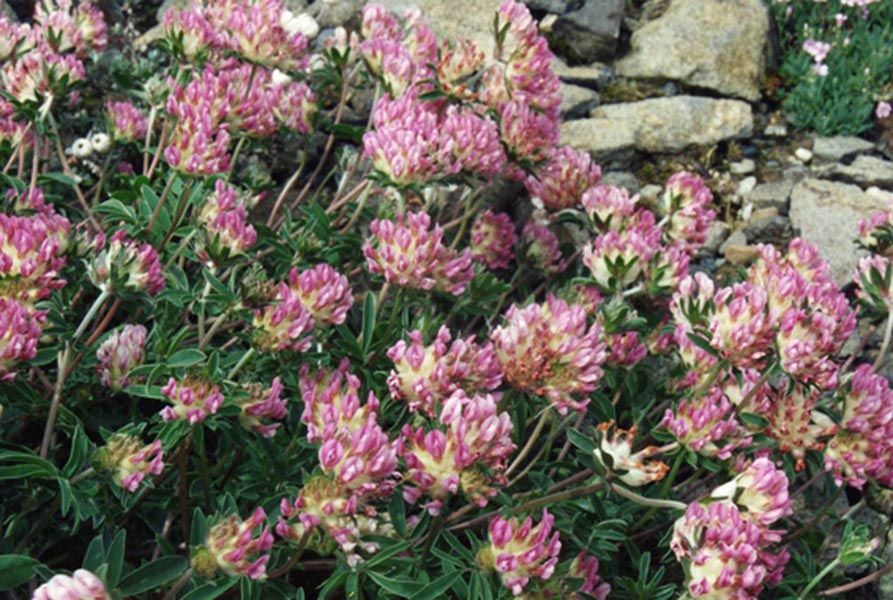
Perennial of the Fabaceae family, this subspecies endemic to the Pyrenees is found on lawns, rock gardens, and calcareous screes at altitude, generally between 1,200 and 2,400 meters, where it colonizes well-drained substrates, poor to moderately fertile, in full exposure or light partial shade.
Its habit is compact and spreading, forming low clumps 10 to 25 cm in height. The foliage, composed of slightly silky elliptical leaflets of a grayish-green, discreetly covers the ground between the rocks. The flowers, grouped in bilobed heads characteristic of the genus, display a soft pink to deep pink hue, highlighted by whitish to slightly pinkish downy calyces, this delicate color conferring on the plant a subtle elegance perfectly matched to the mineral landscapes of the Pyrenees.
Its flowering occurs from June to August depending on the altitude. In cultivation under a temperate climate, it can bloom as early as May in the most favorable situations.
In cultivation, it requires a very well-drained soil, preferably calcareous, poor to moderately fertile, in full sun. It naturally integrates into alpine rock gardens, walls, and mountain gardens, where its pink bloom brings a touch of softness amidst the stones.