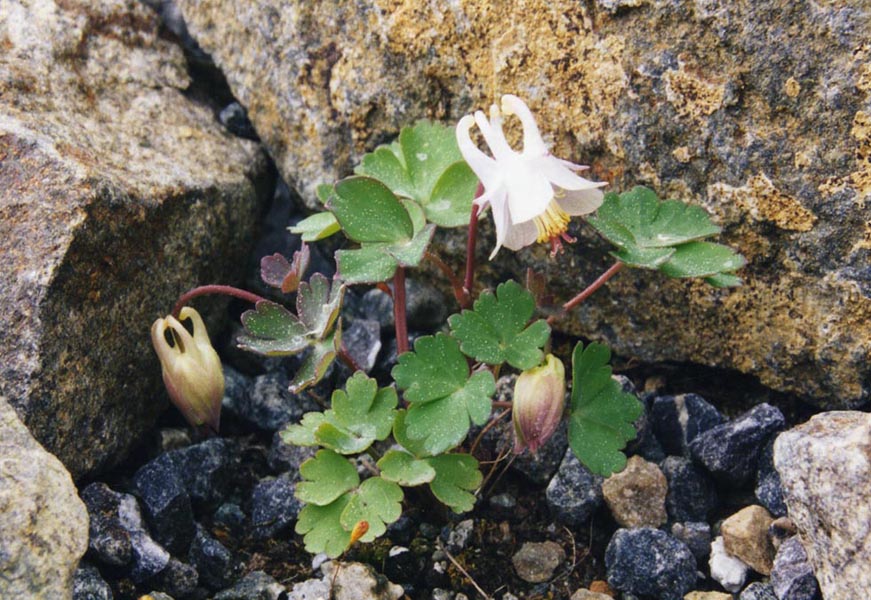
Aquilegia laramiensis is a columbine endemic to a very small range, confined to the Laramie Mountains in southeastern Wyoming, from which it derives its specific epithet. This rare and little-known species to the general public is one of the many examples of the remarkable diversification of the genus Aquilegia in the mountainous regions of western North America, where geographical isolation and local ecological conditions have favored the emergence of endemic taxa with extremely restricted distribution.
Morphologically, Aquilegia laramiensis is a modest-sized plant with a discreet habit, generally reaching 10 to 25 cm in height, which aligns it more with dwarf alpine columbines rather than the large lowland species. Its foliage is biternate, finely cut, with a glaucous-green hue, forming a compact basal rosette from which slender floral stems rise, bearing white to creamy white flowers, sometimes slightly tinged with pale lilac, with relatively short and straight spurs. This light and delicate coloration easily distinguishes it from neighboring species with blue or yellow flowers present in the same region.
Its natural habitat consists of rocky slopes, cliffs, and limestone or shale screes at altitude, in conditions of excellent drainage and protective winter snow cover. It shares this habitat with other specialized plants of the alpine and subalpine communities of the southern Rockies. Its morphological proximity to Aquilegia jonesii , another dwarf species of the northern Rockies, has led some botanists to discuss its phylogenetic affinities, although the two taxa are now generally recognized as distinct.
In cultivation, like most alpine columbines with restricted distribution, Aquilegia laramiensis remains a confidential plant, cultivated mainly by alpine plant specialists and passionate collectors. It requires the classic conditions of well-maintained alpine rock gardens: impeccable drainage, poor and mineral substrate, bright exposure, and protection against excess moisture during the dormant period.