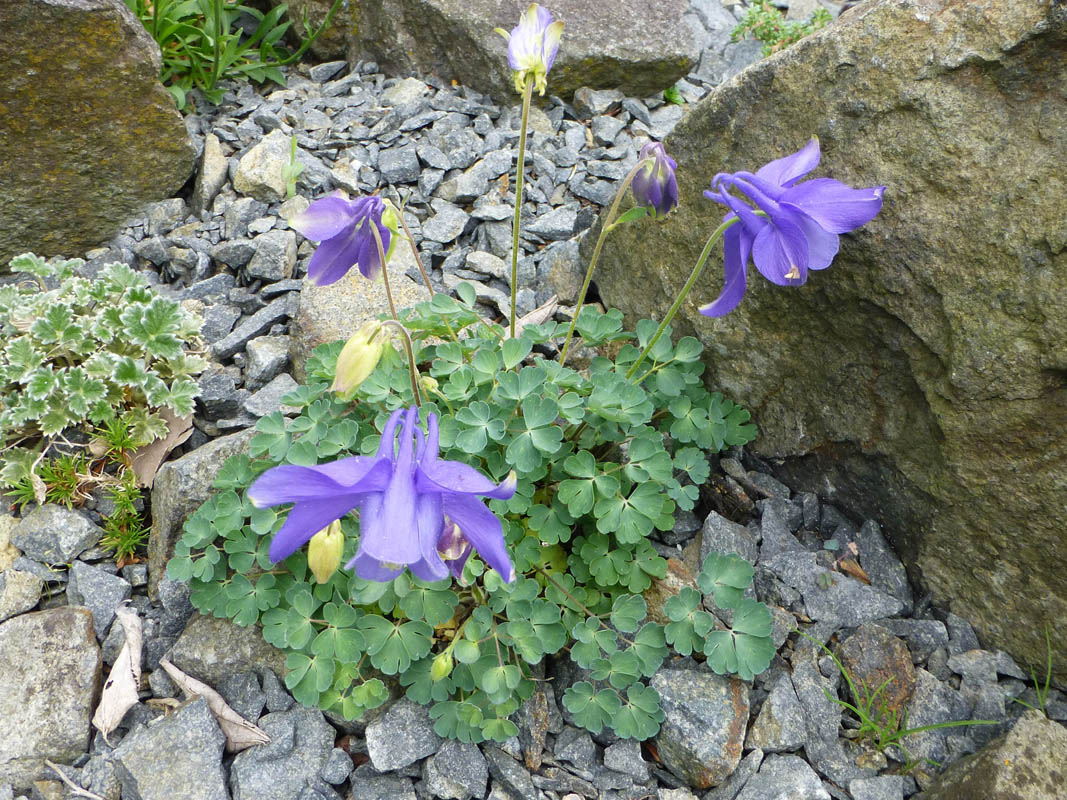
Aquilegia saximontana is a dwarf columbine endemic to the Rockies, whose Latin name literally means "of the rocky mountains", saxi deriving from the Latin saxum (rock) and montana designating the mountains, a direct and explicit reference to its exclusive natural habitat. This species is strictly endemic to Colorado, a state of which it constitutes one of the most precious and characteristic botanical jewels, with a particularly restricted and fragmented natural range limited to the counties of Boulder, Gilpin, Clear Creek and a few adjacent counties of the central Colorado Rockies.
Morphologically, Aquilegia saximontana is one of the smallest North American columbines, reaching only 5 to 15 cm in height at maturity, making it a truly dwarf plant perfectly adapted to the extreme conditions of its high-altitude habitat. Its flowers, proportionately large relative to the size of the plant, display a characteristic bicolor pattern combining blue-violet to lavender blue sepals and white to cream white petals, with short, curved spurs, morphologically resembling Aquilegia pyrenaica subsp. discolor in a remarkable example of evolutionary convergence between alpine columbines of two different continents.
Its natural habitat consists of rocky cliffs, screes, and moist to seeping rock fissures, generally north-facing or in partial shade, between 2,800 and 4,000 meters in the subalpine and alpine zones of the Colorado Rockies. It particularly favors limestone or granite rock faces with permanent or semi-permanent seepage, where it settles in the moist fissures and ledges protected from competition with other plants, in cool and constantly moist microhabitats despite excellent lateral drainage.
Taxonomically and evolutionarily, Aquilegia saximontana belongs to the group of North American columbines with short, curved spurs, a group distinct from the large columbines with long straight spurs like Aquilegia longissima or Aquilegia chrysantha , and whose representatives are generally small alpine plants pollinated by bumblebees rather than hummingbirds or hawk moths. This alpine group with short spurs illustrates a convergent evolutionary strategy with European and Asian alpine columbines, despite an independent phylogenetic origin.
Aquilegia saximontana is a rare and sought-after plant, highly prized by alpine plant collectors and specialists in trough or carefully tended alpine rock gardens.