Perennial of the Caryophyllaceae family, Arenaria ciliata is a circumpolar arctic-alpine species, found in the major mountain ranges of Europe — Alps, Pyrenees, Carpathians, Scandinavian mountains — as well as in Iceland and arctic regions. It occupies short grasslands, stabilized screes, and limestone rock gardens of the alpine and subalpine levels, generally between 1,500 and 3,000 meters in altitude.
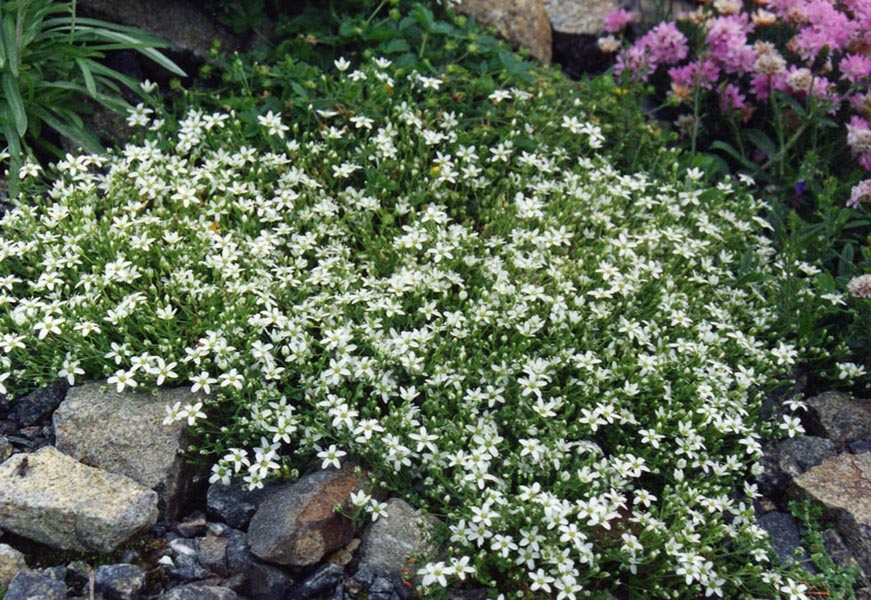
It forms loose to semi-dense, creeping and branched mats, about ten centimeters high, which gradually spread over the substrate without ever forming a compact cushion. The leaves are small, oval-elliptical, medium green, and have well-visible cilia on their edges, giving the species its name and constituting its most immediately observable distinctive feature under a magnifying glass.
The flowers are white, with five entire or slightly notched petals, borne on thin peduncles standing above the foliage. They are produced abundantly and cover the mat with a regular sowing of pure white. In its natural habitat, flowering extends from June to August depending on altitude. In cultivation, it generally occurs from May to July.
It requires a limestone, well-drained substrate, in a sunny to slightly cool exposure, and tolerates harsh winters without difficulty. In rock gardens or alpine troughs, it is well suited to compositions where a discreet and floriferous ground cover with a strong mountain character is sought.