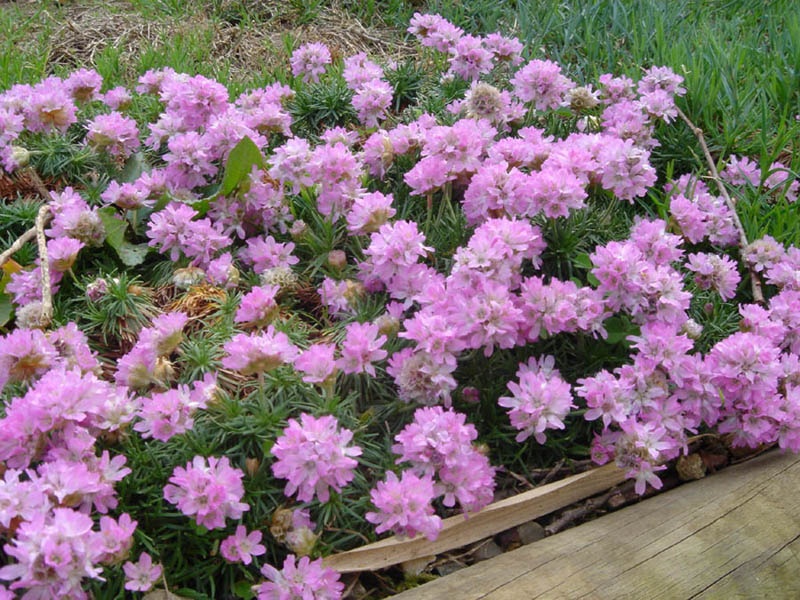
Perennial of the Plumbaginaceae family, Armeria juniperifolia is endemic to the Iberian Peninsula, where it is mainly found in the sierras of central Spain, notably the Sierra de Guadarrama and the surrounding reliefs. It occupies high-altitude grasslands, rock crevices, exposed ridges, and open rock gardens on granitic or siliceous substrates, between approximately 1,500 and 2,400 meters.
It is one of the most compact thifts of the genus: it forms very dense, almost hemispherical cushions, 5 to 10 cm in height, composed of short, rigid leaves, prickly to the touch, of a glaucous green to gray-green, reminiscent in appearance and texture of the needles of certain dwarf junipers, hence its specific epithet. This persistent and hard foliage, perfectly adapted to the windy and dry conditions of its natural habitat, is one of its most distinctive features.
The flower stems are very short, barely taller than the foliage, bearing globular heads of a soft pink to pink-lilac, surrounded by pale scarious bracts. In its natural environment, flowering extends from April to June depending on altitude. In cultivation, it generally occurs in April-May, often from the end of winter in a warm exposure.
It requires full sun, perfect drainage, a poor and mineral substrate, preferably acidic to neutral, and does not tolerate stagnant moisture in winter. It excels in troughs, miniature rock gardens, and well-maintained alpine gardens, where its cushion-like habit studded with pink flowers at ground level immediately catches the eye.