Perennial of the Rubiaceae family, Asperula suberosa is native to Greece, where it is endemic to the northern mountainous regions of the country, notably Mount Athos and the Macedonian and Thracian ranges. It grows there in limestone rock gardens, rock crevices, and exposed stony slopes, between approximately 800 and 2,000 meters.
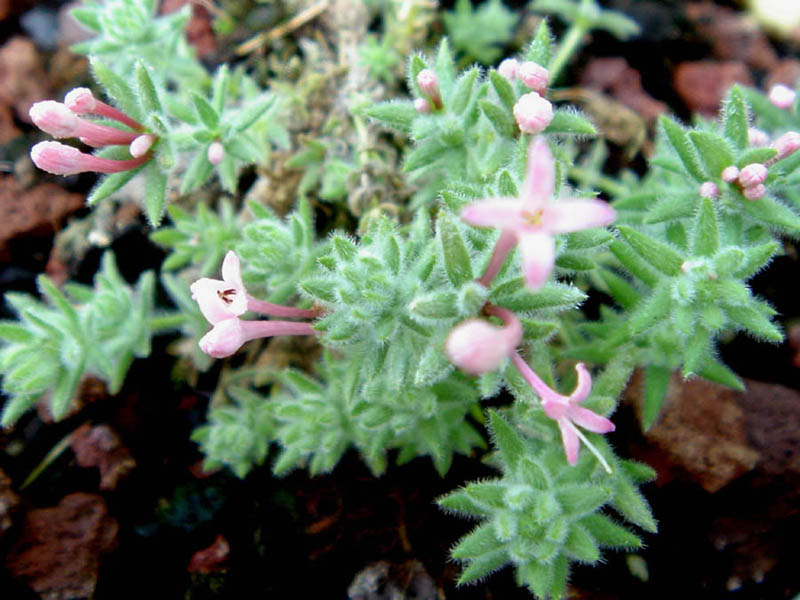
It forms a small loose to semi-dense cushion, 5 to 12 cm in height, with slender, highly branched stems, entirely covered with a dense and soft white pubescence that gives it a characteristic grayish to whitish-green appearance. The leaves are linear-lanceolate, mucronate, arranged in whorls, and their abundant hairiness is one of the most immediately striking features of the species, clearly visible in the photograph where the velvety texture of the stems and leaves stands out even in close-up.
The flowers are tubular, relatively long for the genus, with four spreading lobes of a very pale pink to delicate flesh pink, borne in small terminal groups above the grayish foliage. The contrast between the ashen softness of the foliage and the tender pink hue of the flowers constitutes the main attraction of this discreet species. In its natural habitat, its flowering extends from May to July. In cultivation, it generally occurs in May-June.
Considered one of the most delicate asperulas to cultivate, it requires absolute drainage, a very poor limestone substrate, a sunny exposure, and rigorous protection against winter moisture. Cultivation under cold glass or in an alpine pot with winter rain shelter is strongly recommended.