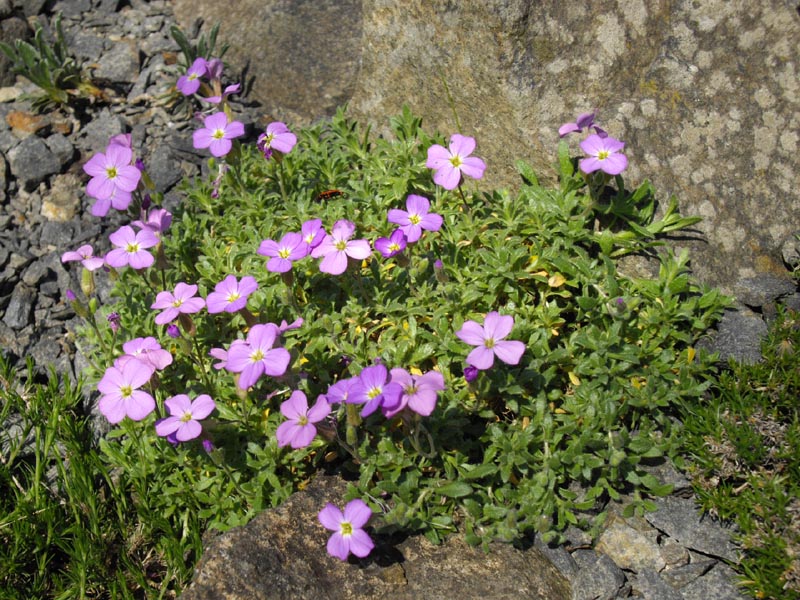
Perennial of the Brassicaceae family, Aubrieta canescens subsp. canescens is a species from the mountainous regions of the Balkan Peninsula and Greece, where it occupies limestone rocks, wall crevices, and sunny screes, generally between 500 and 1,800 meters in altitude.
It forms dense and spreading cushions, 5 to 10 cm in height, with evergreen gray-green foliage, finely covered with a whitish indumentum that gives it its epithet canescens, from the Latin "which whitens". The leaves are small, spatulate to oblong, slightly toothed, and give the plant a very particular velvety and silvery appearance, which clearly distinguishes it from common cultivated aubrietas with bright green foliage.
The flowers are lilac to light violet in color, with four petals characteristic of the Brassicaceae, borne in short, dense clusters above the foliage.
In its natural habitat, its flowering extends from April to June depending on exposure and altitude.
In cultivation, it requires a limestone soil, perfectly drained, in full sun; it tolerates summer drought well once established. Its silvery texture and compact habit make it a plant of choice for rockeries, walls, and Mediterranean dry gardens with a distinctly mineral character.