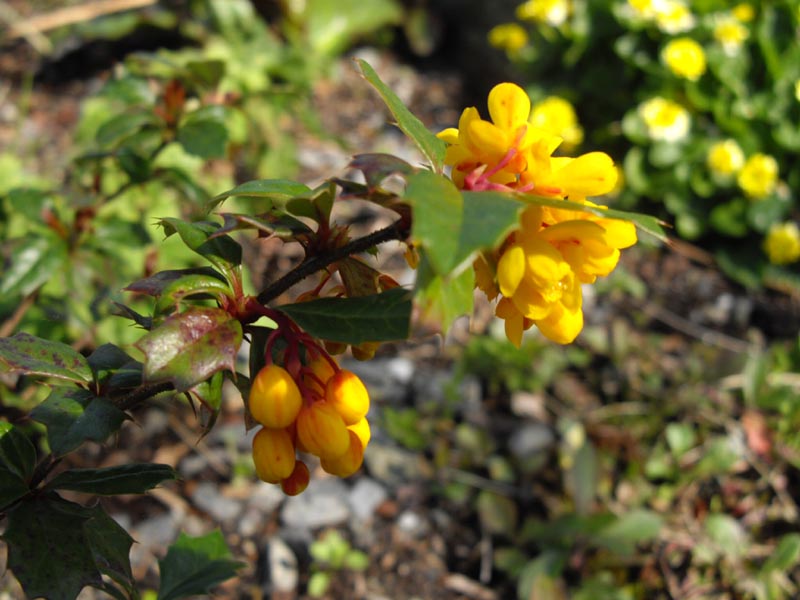
Shrub of the Berberidaceae family, Berberis darwinii is native to southern Chile and Andean Argentina, where it grows in cool temperate forests, wooded edges, and rocky slopes, from sea level to medium altitudes. The species was discovered by Charles Darwin during his voyage on the Beagle in 1835, which gives it its specific epithet.
It forms a vigorous, dense, and thorny bush, reaching 2 to 3 meters in height, with brown-red branches armed with characteristic trifoliate spines. The leaves are small, leathery, shiny, dark green, with spiny-toothed edges, evergreen, making it an effective and decorative defensive hedge all year round.
The flowering is one of the most striking spectacles that a rockery or edge shrub can offer: dense hanging clusters of bright orange flowers with golden reflections literally cover the branches in spring, even before the new foliage is fully developed. They are followed by blue-purple pruinose berries, very ornamental and appreciated by blackbirds and thrushes.
In its natural habitat, flowering extends from September to November in the southern hemisphere. In cultivation under our latitudes, it occurs in April-May.
Hardy and accommodating, it tolerates most well-drained soils, limestone, partial shade, and windy situations. It naturalizes easily and can become invasive in some regions with mild winters.