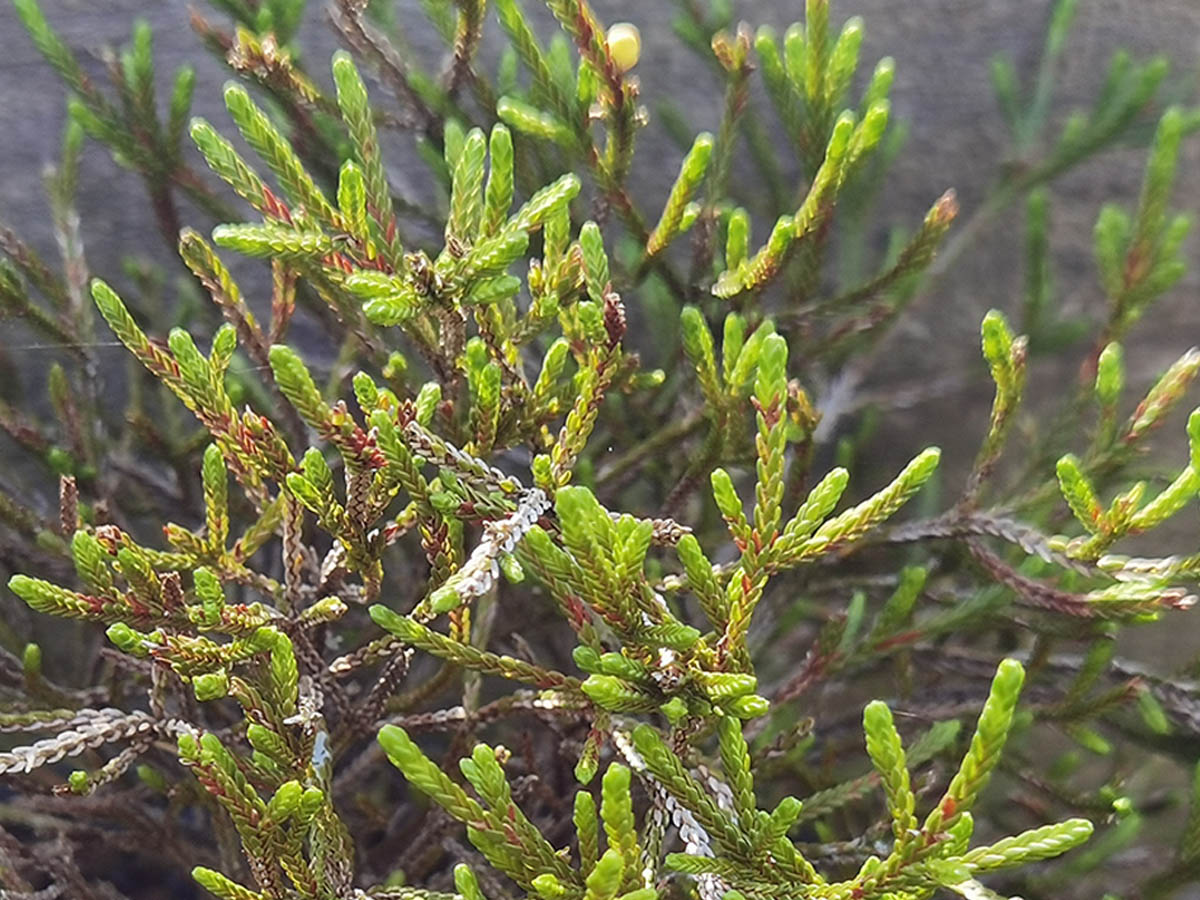
Dwarf subshrub of the Ericaceae family, Cassiope mertensiana is a North American species distributed along the Cascade Range and the Sierra Nevada, from British Columbia to California. The subspecies gracilis, with a more slender and delicate habit than the type, occupies moist alpine and subalpine heaths, the edges of snowfields, and mossy rocks, generally between 1,800 and 3,000 meters in altitude.
It forms loose and upright tufts, more airy than those of C. lycopodioides, reaching 10 to 20 cm in height. The stems, thin and branched, bear opposite leaves, closely applied, dark green to glaucous green, with a characteristic groove on their dorsal side — a distinctive detail observable with a magnifying glass.
The flowers are graceful pure white bells, slightly translucent, borne individually on fine arched peduncles, with a calyx of pale green to pinkish sepals. In its natural habitat, its flowering extends from June to August depending on altitude and snow cover. In cultivation, it generally occurs between April and June.
It requires acidic, peaty, and constantly cool soil, good atmospheric humidity, and poorly tolerates dry heat as well as limestone. A semi-shaded and cool exposure suits it best.