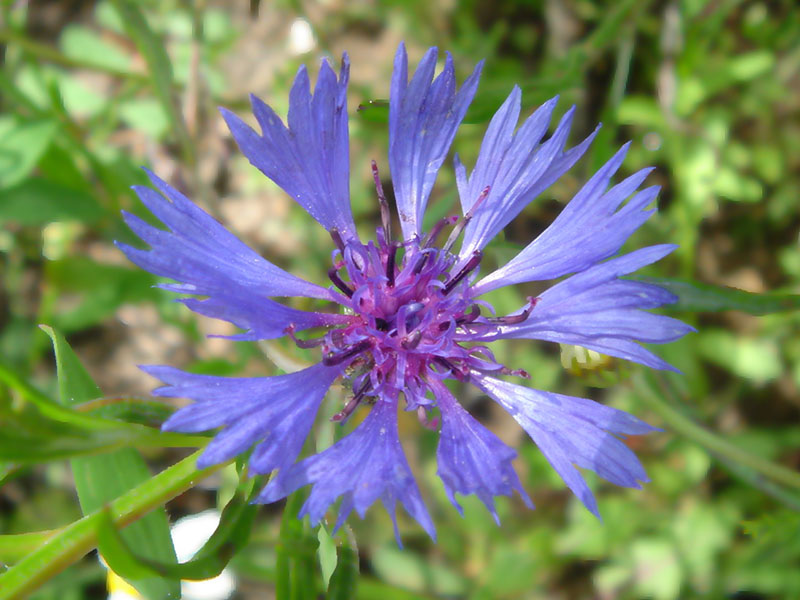
Annual or biennial from the Asteraceae family, the cornflower is native to the eastern Mediterranean basin, probably from Anatolia or the Balkans, from where it has accompanied the spread of cereal crops throughout Europe for millennia. Long a companion of wheat fields, it nearly disappeared with the widespread use of selective herbicides during the 20th century.
It grows on plowed lands, roadsides, and fallow lands, on calcareous to neutral, well-drained soils, from the plains up to about 1,500 meters altitude. The stems are erect, branched, slightly cottony, 30 to 80 cm tall. The leaves, narrowly lanceolate, are gray-green and slightly tomentose.
The wild flower head, more modest than horticultural forms, features deeply cut peripheral ligules of a pure and bright blue-violet, surrounding a heart of dark purple tubular flowers. It is precisely this shade of blue, intense and true, that gave its name to the color cyan.
In its natural habitat, flowering extends from May to August depending on altitude.
In cultivation, a simple sowing in place on ordinary well-drained soil, in full sun, is sufficient. Autumn sowings produce the most beautiful blooms. No special pruning is required; it reseeds itself spontaneously.