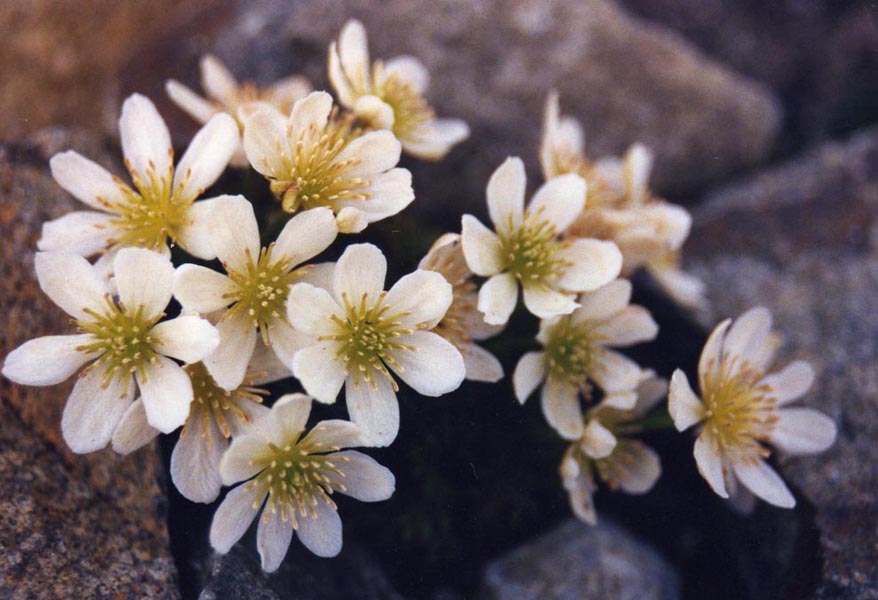
A dwarf, evergreen shrub belonging to the Ranunculaceae family, Clematis marmoraria is native to New Zealand, where it is strictly endemic to the northwestern mountains of the Nelson region, on the South Island. It was only discovered in 1973, making it one of the most recent additions to New Zealand's alpine flora.
It grows in the cracks and screes of limestone and marble rocks, at altitudes of approximately 1,200 to 1,800 meters, in conditions of perfect drainage and bright exposure. It forms small, dense, and compact cushions, rarely taller than 10 to 15 centimeters, with very dissected, dark green, glossy, almost ferulaceous foliage, which itself constitutes a permanent decorative element.
The species is dioecious: male and female plants are distinct. The male flowers, borne on short peduncles, open widely in a star shape, their creamy white tepals framing a center filled with upright stamens, yellow to yellow-green, radiant and luminous. The female flowers, of comparable size, feature a compact cluster of green carpels at the center, more discreet, giving the heart of the flower a matte and globular appearance. In its natural habitat, flowering extends from November to January, which corresponds to the austral summer. In cultivation under our latitudes, it blooms in March-April.
Its cultivation requires absolute drainage, a poor mineral substrate, preferably limestone, and a sunny exposure with protection against stagnant winter moisture. It is ideally grown in a pot in a cold greenhouse or in a very well-drained rock garden sheltered from excessive winter rains. To obtain fruits and thus viable seeds, it is necessary to have a plant of each sex.