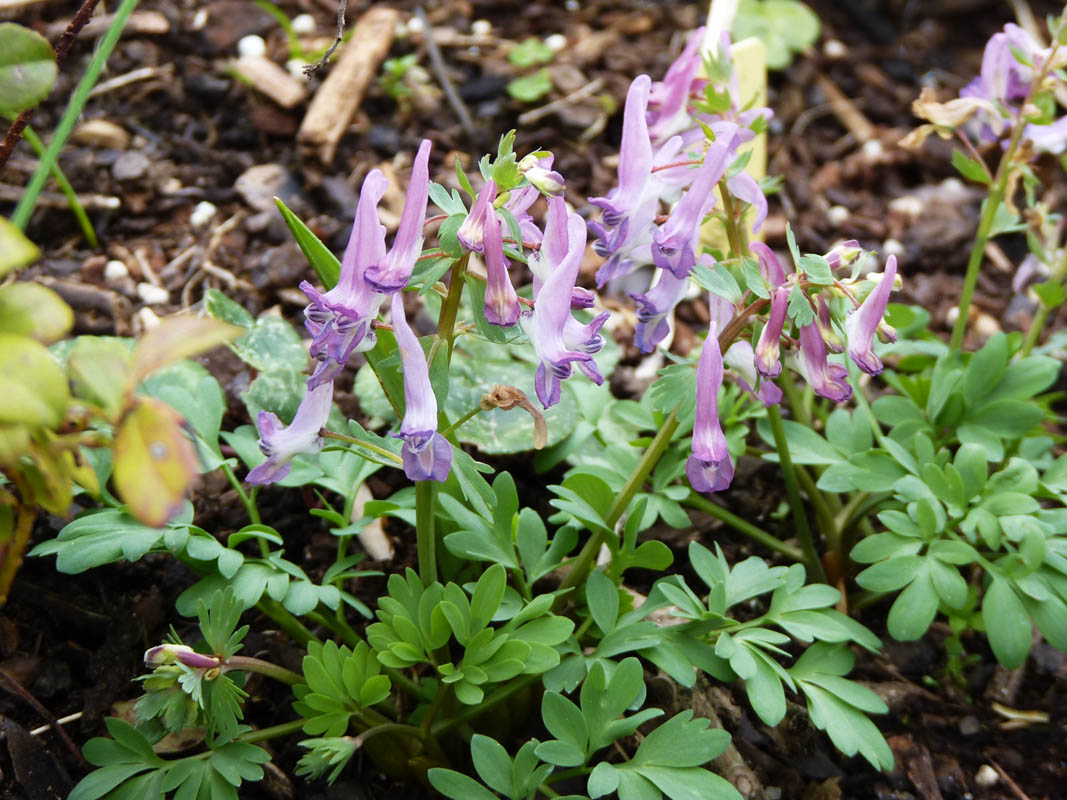
Tuberous perennial of the Fumariaceae family, this species is widely spread across Europe and temperate Asia, from the deciduous forests of Central Europe to Siberia and Central Asia. In France, it is found in alluvial forests, cool woods, and shaded hedgerows, mainly in lowlands and low mountains.
It grows from a solid, rounded tuber, giving rise each spring to short, upright stems 10 to 25 cm tall, ephemeral and graceful. The foliage, a glaucous green finely divided into rounded segments, accompanies the flowering then disappears completely by the end of spring, leaving the ground bare until the following year.
The flowers, grouped in dense terminal clusters, are typically purple-pink to lilac, more rarely white or dark red depending on the populations. A bract deeply cut into strips, located at the base of each flower, distinguishes this species from Corydalis cava, whose bract is entire.
In its natural habitat, its flowering extends from March to April, sometimes as early as February in low and well-exposed stations.
In cultivation, it requires humus-rich soil, fresh in spring but able to dry out in summer, in partial shade under deciduous trees. The tubers are planted at a shallow depth in autumn. It willingly naturalizes under shrubs and discreetly reseeds itself.