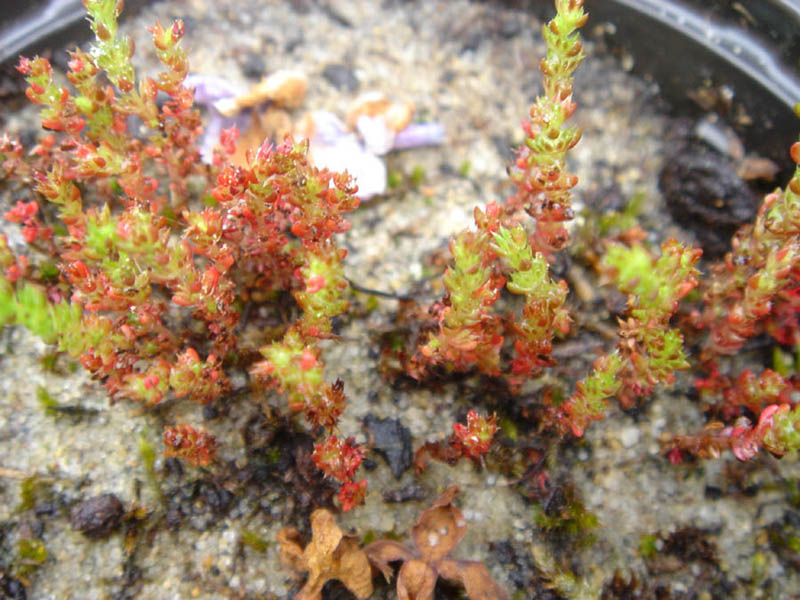
Annual of the Crassulaceae family, Crassula tillaea is one of the few species of the genus native to Europe, where it is found in the Mediterranean basin, North Africa, and as far as Macaronesia. In France, it is notably reported on the Landes coast, where it colonizes the low sandy lawns and trampled paths on siliceous substrate, alongside other very small pioneering annuals. It thrives in poor, compacted, and well-drained soils, often in full sunlight.
It is a tiny plant, rarely beyond 3 to 5 cm, forming small dense and branched mats whose texture from afar resembles that of moss or clubmoss. The leaves, very small, fleshy and overlapping along the stems, turn from bright green to intense red under the effect of water stress or sustained sun exposure, giving the tufts this characteristic reddish hue visible in the photographs.
The flowers are tiny, white to pinkish, axillary, almost invisible to the naked eye. In its natural habitat, its flowering extends from March to June depending on the latitude.
In cultivation, it thrives in a shallow container, on a very poor sandy substrate, in full sun. It reseeds easily and can thus maintain itself from year to year under the same conditions. Its hardiness is satisfactory for a wintering annual.