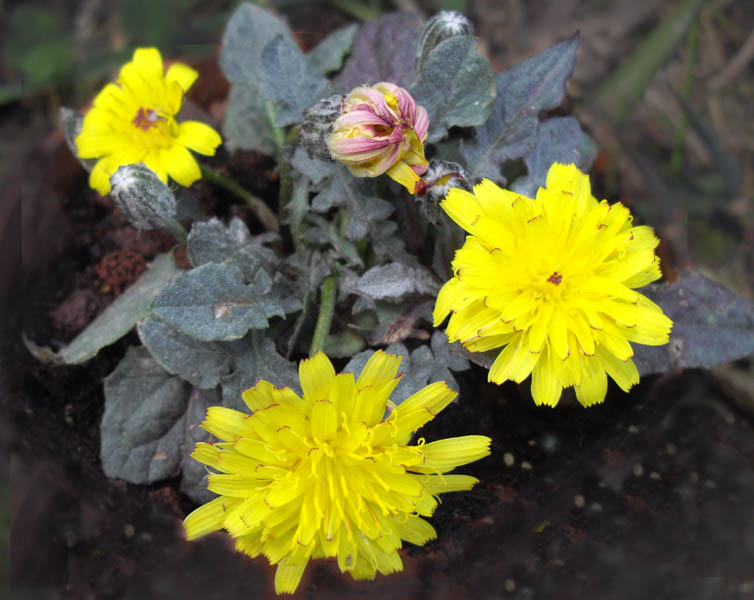
Perennial of the Asteraceae family, Crepis pygmaea is a species of the southern European mountains, found in the Pyrenees, the Alps, the Apennines, and the Balkans. It occupies mobile or semi-stabilized calcareous scree, rock crevices, and coarse gravel areas, generally between 1,600 and 2,800 meters in altitude, among the few pioneering plants capable of establishing on these unstable substrates.
It forms small, low, and spreading rosettes, 5 to 15 cm in height when in bloom. The leaves, oval to spatulate, entire to slightly wavy, are a deep dark green with slate reflections, slightly rough, which gives them a striking visual presence for such a small plant. The flower buds are covered with dense pubescence, and the bracts of the involucre take on purplish hues before blooming, a detail observable up close. The capitula, borne on short slender stems, display ligules of a bright and luminous yellow that contrast sharply with the dark foliage.
In its natural habitat, its flowering extends from July to August. In cultivation, it can bloom as early as June depending on exposure.
It requires a very well-drained, stony soil, poor in organic matter, preferably calcareous, in full sunlight. It does not tolerate excess winter moisture and is advantageously cultivated in a trough or trough with a very mineral substrate.