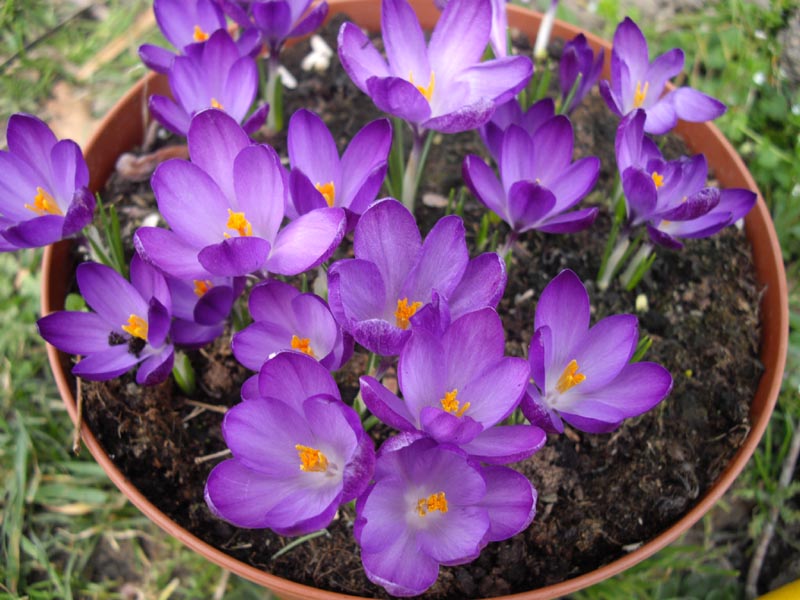
Bulbous perennial of the Iridaceae family, Crocus tommasinianus is native to the Balkans, mainly Dalmatia and Bosnia-Herzegovina, where it grows in open woods, edges, and limestone meadows.
The cultivar 'Whitewell Purple' is one of the oldest and most widespread of the species. It is distinguished by its tepals of a deep purple-violet on the outer face, often enhanced by a darker shade towards the base, while the inner face is a lighter lilac, creating a striking contrast when the flower opens. The throat is white and the bright yellow anthers add their usual luminous touch. The flowers are slightly larger than those of the wild type, which contributes to its success in cultivation. The foliage features the narrow leaves and silver midline characteristic of the species.
In its natural habitat, the flowering of the type species extends from February to March. In cultivation, 'Whitewell Purple' blooms at the same time, being among the earliest crocuses of the season.
Vigorous and prolific, it naturalizes easily by division of the corms and by reseeding, forming large colonies over time. It thrives in well-drained soil, in the sun or under deciduous tree cover. Planted in a dense carpet, the bicolor effect of the flowers between closed buds and open corollas is particularly spectacular.