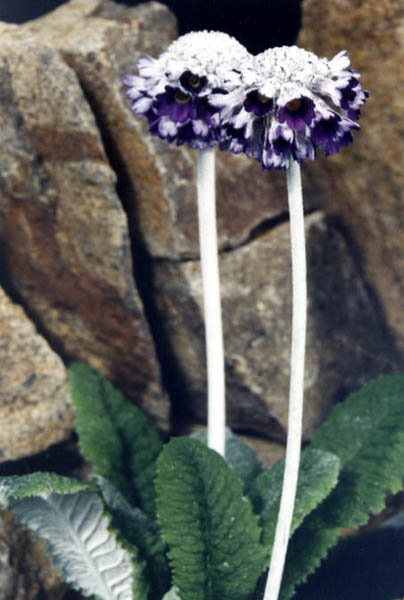
Perennial of the Primulaceae family, belonging to the Capitatae section, native to Sikkim, Bhutan, and southern Tibet, where it grows in moist alpine meadows and grassy slopes at altitude, generally between 3,500 and 5,000 meters.
It forms small compact rosettes of oblong to spatulate leaves, distinctly rough and toothed, medium green on the upper surface and densely farinose, almost white, on the underside. The upright stems, entirely covered with a thick white flour, rise to 15–20 cm and bear at their top a dense globular capitulum, also very farinose, from which the flowers emerge. These are a deep purple-violet to violet-blue, with tubes and calyxes covered in whitish flour, creating a striking contrast between the snowy white of the capitulum and the intensity of the open corollas. This combination, visible at all stages of flowering, is one of the most unique spectacles of the genus.
In its natural habitat, its flowering extends from July to August depending on altitude. In cultivation, it generally blooms from June to July.
This subspecies is distinguished from the type subspecies by its more broadly toothed leaves and particularly abundant flour. Sometimes considered biennial or short-lived in cultivation, it readily reseeds itself. It requires well-drained soil but not drying out in summer, rich in humus, in a sunny to slightly shaded exposure, in a cool climate. It is cultivated in moist rock gardens, in containers or in a cold greenhouse.