Perennial of the Primulaceae family, Primula hirsuta is a species of the Alps, present from the Maritime Alps to the Eastern Alps, with some stations in the Pyrenees. It occupies fissures of siliceous rocks, scree, and acidic rock faces, generally between 1,500 and 3,000 meters in altitude. Its marked preference for siliceous substrates distinguishes it from many other calcicolous alpine primroses.
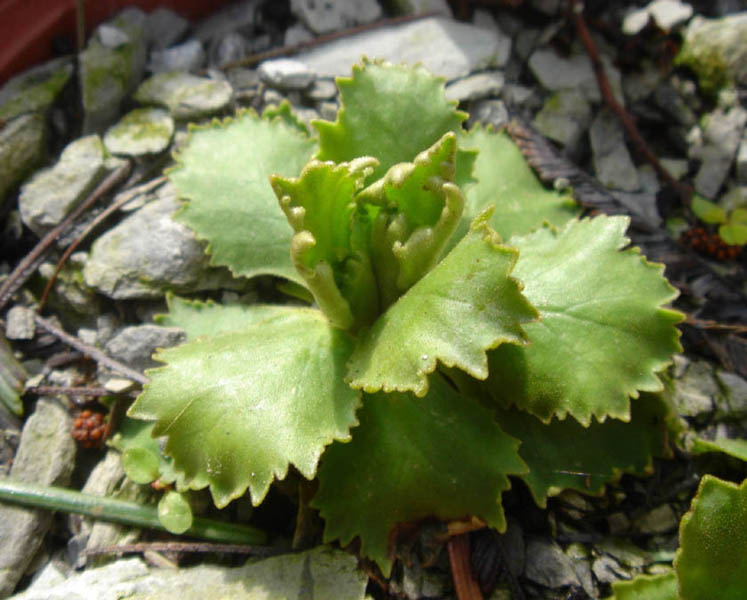
It forms small compact rosettes, borne on a short stipe that gradually elongates with age, with dead leaves persisting around the collar — a characteristic clearly visible outside of flowering. The leaves are oval to spatulate, medium green to bright green, with crenate margins, covered with viscous glands and glandular hairs that give them a slightly sticky feel, a distinctive trait of the species.
The flowers are bright pink to lilac pink, sometimes almost purple, with a well-defined central white eye, gathered in umbels of a few flowers on stems 5 to 10 cm tall. The petals are distinctly notched. In its natural habitat, its flowering extends from May to July depending on altitude; in cultivation, it generally occurs in April-May.
It strictly requires an acidic or neutral, well-drained substrate, without active limestone. In siliceous rock gardens or in a container with a mix based on granite or coarse peat, it performs well provided any water stagnation at the collar is avoided in winter.