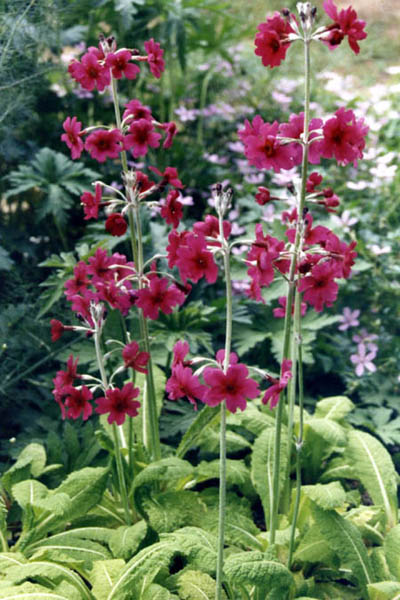
Perennial of the Primulaceae family, belonging to the Proliferae section (candelabra group), native to western China, mainly Sichuan, where it grows in high-altitude wet areas, stream banks, and marshy mountain meadows.
It forms a large rosette of oblong to obovate leaves, heavily wrinkled and crenate, with a matte green color, reaching 30 to 40 cm in length. The flower stalks, upright and very characteristic, are densely covered with a white powder — the bloom that gives the species its epithet — contrasting strikingly with the flowers. This pure white powdery stalk, visible from the earliest stages, is one of the most immediately recognizable traits of the species among the candelabra.
The flowers, gathered in well-spaced tiered whorls, are a deep crimson-red to magenta, with a dark almost purplish-black eye that further intensifies the overall hue. The stalks reach 60 to 90 cm under favorable conditions.
In its natural habitat, its flowering extends from May to July. In cultivation, it generally blooms in May-June.
The 'Bartley' cultivar with salmon-pink flowers, selected in the early 20th century, remains one of the most appreciated horticultural forms. The species requires constantly moist soil, rich in humus, in partial shade or full sun if moisture is ensured. It is particularly spectacular when planted in dense groups at the edge of a water feature or stream.