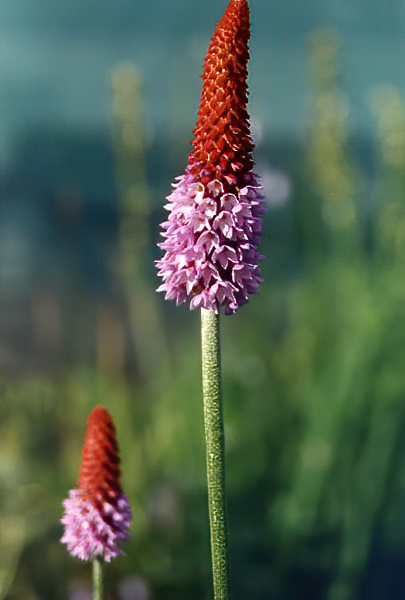
Perennial of the Primulaceae family, belonging to the Muscarioides section, native to southwestern China, mainly Yunnan and Sichuan, where it grows in high-altitude humid meadows, stream banks, and mountain marshy areas, between approximately 2,500 and 4,000 meters.
It forms a rosette of large lanceolate to oblong leaves, softly hairy, slightly toothed, of medium green, reaching 20 to 30 cm. The upright flower stalks rise to 30 to 50 cm and bear a dense, conical spike that constitutes the most singular feature of the species in the entire genus.
This spike presents a striking and progressive bicoloration: the top, formed of still closed buds, is scarlet red to intense crimson red; the lower part, where the flowers open from bottom to top, takes on a lilac to pinkish-purple hue. This gradient from red to lilac, visible at every moment of the blooming, is immediately recognizable and unparalleled in the Primula genus.
In its natural habitat, its blooming extends from June to July. In cultivation, it generally blooms in June.
The species is often described as not long-lived under our climates, sometimes behaving as monocarpic or short-lived perennial; however, it readily reseeds itself in favorable conditions. It requires constantly fresh to moist soil, rich in humus, in a semi-shaded exposure, and does not tolerate drought.